
Intimately bound up
Feminism and Emancipation

Since I started writing this blog about the books I read, there is one on my list that deals with issues that are still being claimed for the rights that correspond to us as human beings, race equality, and gender equality.
On the other hand, I was always interested in why the title of this work was better known abroad than in the Commonwealth of Dominica, where I live. It is required reading in many British schools, but not in the education system of the Caribbean island.
We are going to delve deep but easily into the wonderful book Wide Sargasso Sea (154 pages), a novel about emotional life and its passions written by Dominican-born British author Jean Rhys (1890-1979).
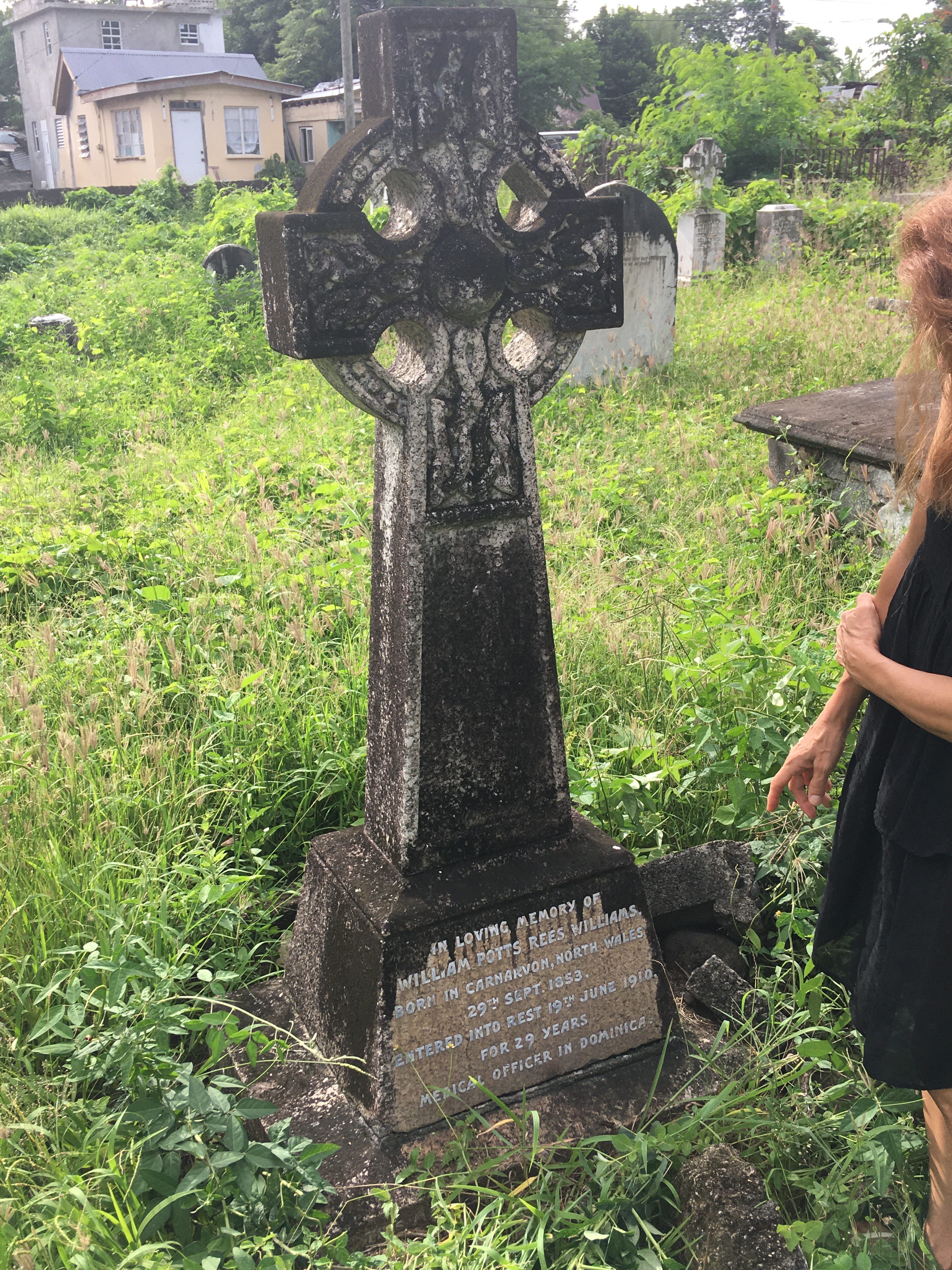
She was born in Dominica on 24 August as Ella Gwendolyn Rees Williams. Rhys's father, William Potts Rees Williams, was a Welsh doctor, and her mother, Minna Williams, née Lockhart, was a third-generation Dominican Creole of Scots ancestry1.
Perhaps after reading me, your interest in this bold woman increased. While I was researching more about the author, I found that Miranda Seymour wrote Jean Rhys’ biography “I Used to Live Here Once”.
Jean Rhys's family frequented the Anglican church at the roundabout in Roseau, (Dominica’s capital) opposite Fort Young Hotel. This is the reason her father is buried in the graveyard behind the Newtown savannah. “A headstone topped by a Celtic cross is a reference to Rhys' father's Welsh background”.
Jean Rhys read Jane Eyre by Charlotte Brontë (1847) as a child and tried to imagine what the life of Bertha Mason's character might have been like. Jean Rhys hated the way Rochester's first wife was portrayed in Jane Eyre and tried to dignify her by cultivating such a narrative, beginning with Antoinette Mason's story from her youth in Jamaica, to her unhappy marriage to a certain anonymous English gentleman (Edward Rochester), who changes her name Antoinette to Bertha, pronounces her insane, takes her to England, and isolates her from the rest of the world in his mansion. From this moment on, Antoinette finds herself trapped in an oppressive patriarchal society in which she belongs neither in Europe nor in Jamaica. Madness is in the air.
One of the most fascinating aspects of this novel is how Jean Rhys imagines her character's childhood and youth to be.
Wide Sargasso Sea was first published in 1966 as a feminist and anti-colonial response to Charlotte Brontë's novel.
It is important to highlight that Wide Sargasso Sea is not a sequel to Jane Eyre but a prequel. The narrative events in Rhys's novel are meant to take place before those in Jane Eyre.
Wide Sargasso Sea is attuned to race relations in the Caribbean, especially in the islands colonized by the British. Rhys writes about the immediate post-slavery period in the West Indies. By then, Jean Rhys had been living in Europe for decades.
The Emancipation Act freed all slaves in the British Empire in the 1830s and Wide Sargasso Sea is approximately set in the immediate 10-year period after that. The author narrated exploration of the relationship between former slave owners and former slaves. There is a lot of hostility between the white and black populations depicted in part one of the novel.
The country and the Caribbean people are there, surrounding everything, but when it is seen without understanding, it happens that comments like the one that Edward makes as his impression of how he sees all, look overwhelming.
Everything is too much, I felt as I rode wearily after her. Too much blue, too much purple, too much green. The flowers too red, the mountains too high, the hills too near. And the woman is a stranger. (WSS, p. 59)
Something that infuses this novel with complexity is that there are different aspects of the story. The book is divided into three parts.
When the novel begins, Antoinette is still a young girl living in Jamaica. Antoinette's parents are former slave owners. She belongs to the white aristocracy, which went into decay after the Emancipation Act of 1833 came into full effect and one year after black slaves had been freed. She lives with her mother Annette, who is a widow, and her younger brother, Pierre in an estate that had seen better days. They have some black servants who gossip a lot about the family and about how they are ostracized by the local upper class. This first part is narrated by a young Antoinette.
The second part is narrated by Antoinette's English husband, Edward. He is Mr. Rochester but his surname is never mentioned in Wide Sargasso Sea.
The third part takes place in England and is narrated by Antoinette a little bit muddled because of her mental state.
What I find interesting about Wide Sargasso Sea is the fact that after reading it, there is difficult to separate the story from Jane Eyre, and vice versa. I have not read Jane Eyre but I saw one of the versions of the movie (with Orson Welles as Mr. Rochester) and once you know both narratives, you just can't leave one apart.
Anything related to race and the intricacies of racial identity was fascinating to me. The fact that Antoinette will never be as white as the European-born white just because she was born outside of Europe and how she is explored in the novel is catchy. My dad was always the 'Musiú' in his chosen land and seen as a foreigner in his homeland. I never saw myself as a white person, but this is how I am seen in Dominica.
Racial identity is not the only aspect of Antoinette that works against her. The other is gender, of course. Although she is white, she practically becomes a slave for being a woman. She does not become a slave in the sense that she is forced to work because never worked, but in the sense that she is handed over to a white man who considers her less than, and part of, his problem. Here, Mr. Rochester doesn't buy her, he actually gets paid to have her. But he comes to possess her, so much so that he even changes her name without any explanation to Bertha. And he, too, rips her out of Jamaica and takes her to England without even consulting her!
Rhys brings the racial tensions present in the early 19th century to life in the novel through the stories of Annette and Antoinette. Among the “black-white population of Creoles, these ladies who had a better position than blacks in society had to face many problems because of their Creole status” are the most important way she shows us a reality.
Wide Sargasso Sea is a critique of English colonialism but also a romantic narrative with a touch of the supernatural involving a repeated reference to madness in various characters, making this an important theme in the novel.
The other thought about Wide Sargasso Sea is how autobiographical Jean Rhys was. In my opinion, it's always about her. She seems to be an author whose story is intimately bound up with her writing.
José Ramón Díaz Fernández2, in his Essay "Jean Rhys and Wide Sargasso Sea" points out how important it was for the Dominican writer the publication in The New York Times Book Review by the prestigious critic Alfred Alvarez, dedicated to her: "The Best Living English novelist".3
Even though she wrote several novels in the thirties, receiving good reviews but unnoticed by most of the public. It is known that she spent many years without writing but after her reappearance, the literary change did much for her, this time her stories were autobiographical, narrated in the first person, in addition to offering contemporary themes. In general, the characters of it are always women who struggle against the disadvantages of earning their own money. Women know that they are destined to succumb to a world ruled by men.
Thanks to the above-mentioned article is that Jean Rhys resurfaces and it even becomes easier to acquire copies of her works. And as Díaz Fernández assigned, it is unfortunate (although I would add that it is nothing more than a marketing issue) that the publisher Pinguin, in its paperback edition, adds the following comment below the title of the book; "The extraordinary story of the first Mrs. Rochester, the mad wife of Charlotte Brontë's Jane Eyre."
What is certain is that Jean Rhys devoured the book Jane Eyre to let her imagination run wild and play a voiceless character in Brontë's novel, giving her own voice as the main character in her novel Wide Sargasso Sea. This is what we must learn from. A voice to the voiceless.
Creole, in this context, means a person of European descent born in the colonies.
José Ramón Díaz Fernández, Atlantis, vol. XIII, no. 1, June 1990 (77-102) Essay “Jean Rhys & Wide Sargasso Sea”.
Alvarez, Alfred: The Best Living English Novelist, The New York Times Book Review, March 17, 1974, pp. 68. https://www.nytimes.com/1974/03/17/archives/the-best-living-english-novelist.html